
Thinking from 1st principles - The OG of mental models
Bonus - Learn how to circumvent the pitfalls for this mental model

A 1st principle is a foundational proposition or assumption that stands alone. We cannot deduce first principles from any other proposition or assumptionAny discussion about mental models is incomplete without understanding how 1st principles thinking works. All Mental models are somewhat a hack to use 1st principles to make critical decisions.
Most people don’t understand how to develop 1st principles thinking and mostly rely on conventional wisdom or reasoning by analogy and lastly experience (later in life). Lets 1st explain how the other models work and then we can talk about 1st principles and why is it better
A) Conventional wisdom
This is what is accepted wisdom in society. For example, while growing up in India in 90’s, what everyone knew is that if you are good in academics, you take up Science and pursue either medicine or Engineering. If you are average then Commerce and bad then Arts
This is where most people are stuck. For example, post IIT I have been advised by most people to do an MBA, as an IIT-IIM combo would be gold in the job market. Or that an IIT-Ivy League pedigree would ensure the money keeps flowing in.
Not taking away from people who did take this path. It ensures that your probability of achieving success/money is much higher and also a safer bet. But was this path suited to you and your unique constraints, desires and ambitions. For that you need to reason from 1st principles.
Remember that conventional wisdom exists for a reason. Because many people found success by following that path. It’s a set path and you need to convince gatekeepers to let you in at every step. But do you want to follow a set path or do you want to be a trail-blazer, to live on your own terms and still achieve success? That’s a personal choice.
Also conventional wisdom path always keeps getting revised. Starting your own startup was very new-age 15 years back, today it’s a craze. In the age of Shark Tank, everybody wants to be a startup founder. 5 years back it was cringe but now everybody wants to be a social-medial influence. So conventional wisdom updates itself but always at a lag. All 1st generation successful people have strayed from conventional wisdom at some point in life. It’s important to know when. Till then use the conventional path as a safe habour or a peer group comparison
B) Reasoning by analogy
This method is based on effective comparisons. This basically implies reasoning by adjacent knowledge. Taking an example from my own life, I know most IIT graduates take up careers in finance/consulting as that’s where the money is. So reasoning by analogy means that to make money I should also take the same path.
Many people follow this analogy and have taken up careers in these fields. They are also doing well financially. But what is the long-term career goal? Is that the most optimum path to differentiate yourself in a 30 year career? Jury still out
Reasoning by analogy depends on a precedent already set about certain similarities between two situations and how they play out. A great way to use this is to compare what things are similar compared to the benchmark situation and what attributes are different. And then knowing which attributes you want to incorporate from the benchmark situation.
Remember reasoning by analogy gives you a benchmark but not the optimal solution. If you want the true solution, you should try to beat this benchmark
C) Experience
This is the most tricky one. Sometimes your experience in a field helps you with knowledge, insights, networks, and gives a kickstart. Other times it hampers your thought process of truly novel solutions. A lot of what you have learnt through experience is non-intuitive. As data or logic might not point in that direction but experience has taught you that it works well. But it’s important to know that sometimes experience can be narrow or context driven. How large companies work is very different from fast-growing startups. Being a functional head for a large MNC is different from running the business in a small company.
Of course some careers have a entry barrier you must cross. You must have an MBBS degree to become a practising doctor. Or a CA degree to file accounts in India. But beyond a point, the degree doesn’t help you. To be an outlier you must learn to be different than the crowd, to think different and for that you must avoid the pitfalls of the masses and think from first principles.
All 3 of these methods will help you get average returns in general as they are comparatively less risky and are based on certain precedents. If you want truly outlier returns in your life, you must learn how to think from 1st principles. Also you can start thinking from 1st principles any time in life. While in these 3 methods, you might feel like you missed the boat at some point, 1st principles thinking is fundamental and you can start whenever you wish.
D) 1st Principles thinking
This is the final piece of the puzzle. This relies on a realistic assessment of the
Situation/Context
Your internal self-awareness
Goals/ambitions and constraints
Immutable laws/Assumptions/Forward bets
To reason from first principles you first have a establish certain facts regarding the above 4 which are true beyond reasonable doubt. Then you must breakdown the situation/decision into its fundamental blocks. Stress test your assumptions/constraints and build on this with a working hypothesis/plan. Keep refining it with real world feedback and use it to shape a new reality/forge a new path
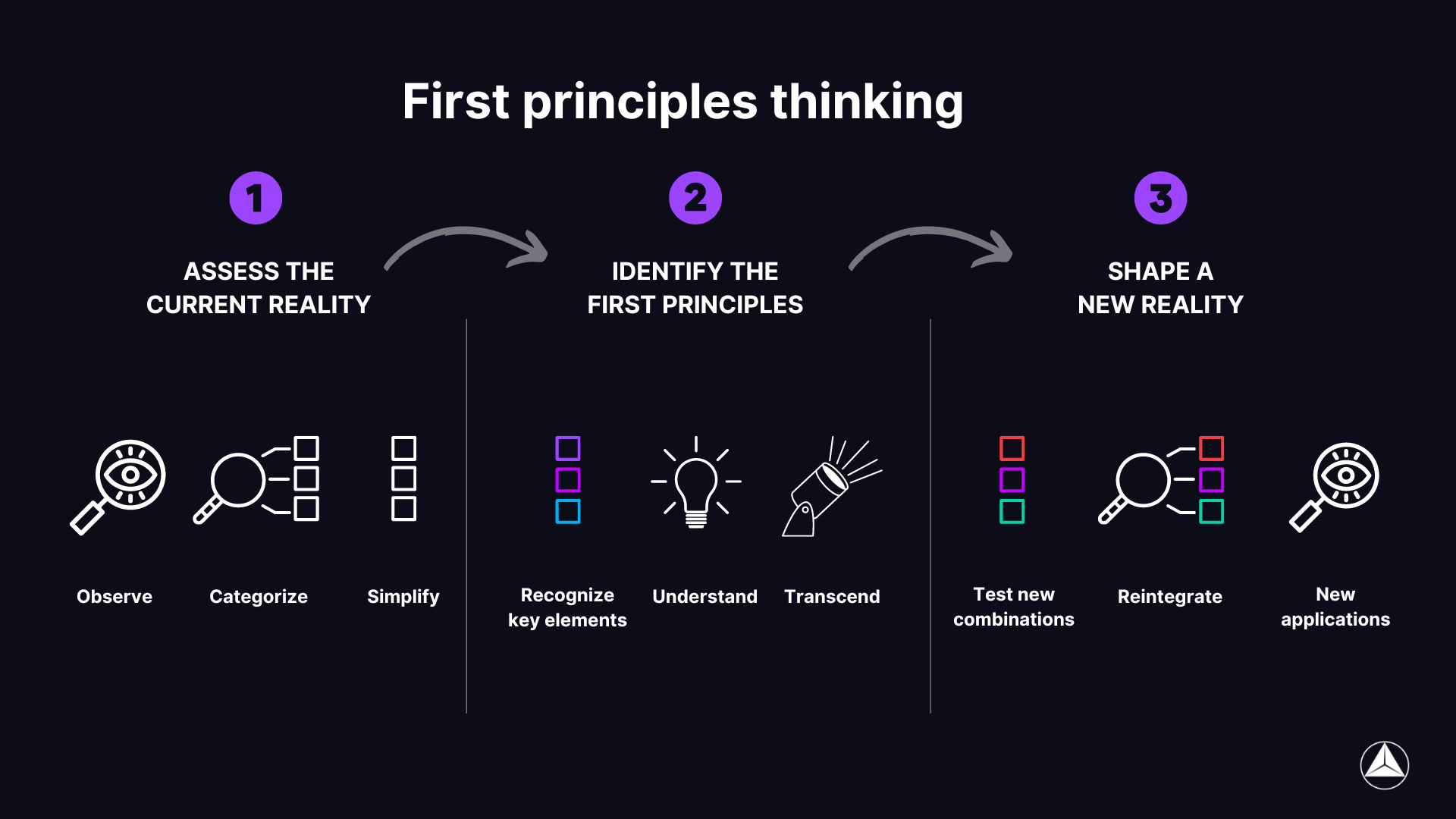
Conventional wisdom & reasoning by analogy serves more as filters or safety nets when 1st principles fail or you can’t sustain them. Remember that thinking by 1st principles will give results in the long-term (min 5 years) whereas other approaches are safer and you will get market validation earlier. So when you are working with 1st principles you must have the ability to survive the short-term or else you will have to quit/ jump ship to the conventional safe harbour route.
A key distinction exists between 1st principles and continuous improvement. Continuous improvement focusing on incremental innovation within the confines of the original vision. 1st principles requires you to focus on “Function” over “Form” and lead to completely different outcomes. Examples includes “flying cars”. Well the form of a “Car” doesn’t matter. We already have the functional solutions called “Airplanes”. Same goes for suitcases with wheels. Although both have individually existed since centuries, no-one thought of combining them, that is till 1970. So a combination of different things can lead to revolutionary outcomes.
To be fair, 1st principles doesn’t skip continuous improvement. But it definitely changes the direction and trajectory of improvement. The path to realising your 1st principles outcome might be messy and you will need tactical manoeuvres & continuous feedback/pivoting to realise your ambitions.
Why is 1st principles thinking better?
The basic reason is that it allows you to really understand things at the atomic level. Not superficially. So that when things go wrong, you know exactly why it went wrong and what you need to do to correct it. If you rely on conventional wisdom or reasoning by analogy or experience, you won’t know the reason you failed. Also in success, you won’t know what you did right, whereas when relying on 1st principles, you will know what went right. It helps you live life and make decisions deliberately rather than following someone else’s system.
Personal anecdote?
Lets take a look at how I evolved the decision of what to do after IIT using 1st principles. Remember I evaluated and created all the options with conventional wisdom/reasoning by analogy and used experience to pivot as and when necessary.
Conventional wisdom told me to take Science as I was good at academics, which I followed as I wasn’t clear what I wanted to do anyways. Was just clear about not pursuing biology and hence took up Engineering. My getting into IIT story requires a separate post.
Then in IIT as it became clear to me that I wanted to start my own business (around 2011/12), I started speaking to people with that filter. Most people then were caught up in the tech startup bubble (2012-2015). Early days of Powai valley in Mumbai and startups like TinyOwl and Housing.com (funded by Softbank) and there was massive FOMO about this. Then I reasoned from first principles that I was studying metallurgical engineering (circle of competence) and was also good at it. Also it was obvious to me that if India had to go the China way, manufacturing would have to pick up. Remember this is before Modi (2014) and also before Make in India. So I reasoned that a startup in materials manufacturing would be the right direction.
I eventually landed an internship in Japan in May 2013 at JFE Steel, 2nd largest steel company in Japan and first hand saw how a large metals/materials manufacturing company works. Also got a new data point, that the highest rankers in Engineering Entrance Exams there choose metallurgy as the preferred department v/s Comp Science or Electronics in India. Japan is a manufacturing powerhouse. This data point coincided with my insight that Manufacturing in India will pickup and hopefully my expertise would be valued in the long-term in India. But didn’t how long-term
I came back to India and was quite sure of doing a startup in Manufacturing. But peer pressure, the placement fever took over and I along with my cofounder decided to spread our bets. We gave the GRE/TOEFL and also sat for placements. I ended up rejecting the PhD route as that led me to a min 5 year commitment in the US. I saw the opportunity to be in India in the long-term and also emotionally wanted to stay in India in the long-term. I could always come back later (many have done so now). But I thought R&D in the US would not be useful as it’s too cutting edge and India is still in nascent stage of development. Also after studying for 4 years, I really didn’t want to spend 5 more years in a lab. I’d rather hit the market running. Building a company in the US also didn’t excite me and so that option dropped off. I never applied for PhD.
Placements started off well and I got shortlisted for 2 Day 1 interviews. 1 in finance (Top Tier) and 1 in consulting (not Top Tier). I ended up bombing the final HR round in the final interview in finance one because of a careless comment and ultimately got 2 offers on Day 3. One in a Finance hedge fund in Mumbai and other in a Manufacturing company in Japan. Both were well-paying jobs and the 2nd one had the advantage of being a foreign job and the status that comes with it.
The 1st job offer was the conventional path of work in finance and make money. My interview prep for the Day 1 job had made me realise that I actually liked finance but it was a conventional path and not the best finance job out there. The fact that it was a startup did excite me but I ended up rejecting it eventually.
The 2nd offer took some time. I initially accepted it. They were going to have a 2 month Japanese language training program which almost confirmed my decision to go. My final semester in IIT however turned the tide
I reasoned to my myself, I already had a degree from IIT which is a strong brand in India. On resume, I had a 9/10 GPA with a strong brand foreign internship. My interview skills had also become decent to the point that I was confident that I would land at least some job in a worst case scenario (startup failing). So the downside was only time, money and risk. Also I thought that risk appetite was highest now as I had no responsibilities. My expenses were low. 2 years wasted now wouldn’t matter much. I’d still be able to catchup with my peers and also do an MBA if required. Typically my peers went to IIM within max 2 years post undergraduation and Ivy-league MBA post 4-5 years of undergraduation. My options were still open. This was an asymmetric bet with low downside and high potential upside. Also in case of failure, the learning would be tremendous
So over a bottle of Jim Beam, we decided to reject our job offers and take the plunge. The decision to take the plunge came from ultimately reasoning from first principles and eliminating all the options via the other 3 thinking methods. In fact experienced people simply advised me to take a job and I know from hindsight this was well-meaning advice. The asymmetric nature of the bet sealed the decision for me. In difficult times, this framework of thinking and the concrete reasons why I took this step helped me power through and not loose hope. Thinking from 1st principles is like a muscle and more you use it, more you learn to rely on it.
Skipped quite a few details but hope this was interesting!. Will cover my post IIT story in another post.
Like/share if you found this useful and follow/subscribe for similar content